
Licensed under
CC BY-SA 4.0


 : also see my full Copyright statement.
HELP REQUIRED! This website/book has (for technical issues) been written using a plain ASCII text editor, and so contains quite a few typo's.
If you find any and have a couple of minutes you can report them - see
contact page!
Consciousness is probably one of the most debated and therefore confused topics it is possible to look at [1]. I have taken a pragmatic and empirical approach, because I want a practical application to come out of the other end of the sausage machine. An approach based on observation is necessarily iterative - any interpretation then colours the subsequent interpretation of further observations. I spent a couple of decades doing my best to accumulate uninterpreted experience, but in the end interpretation is necessary - after all, we are not computers, live a life, have belief systems, biases, prejudices, etc. - some of which are implicit rather than conscious.
It is quite difficult to separate the idea of intelligence from consciousness - and we have another word for consciousness that is a be-ing without (overtly expressed) intelligence: sentience. So when thinking what consciousness might be, one avenue is to consider what other forms of life exhibit clear intelligence instead of activity that might (possibly) be considered automaton-like workings of chemical complexity. Intelligence might be defined here as : meaningful adaptive and inventive response to environment and to other intelligent beings, problem-solving, memory, capacity to learn, including possibly language. That can also be (optionally) extended to learning when young through play, complex relationality: signs of friendship, socialised behaviour that does not make thermodynamic sense (and so is unlikely to be automaton-like), compassion and other meaningful relational behaviours. When we use these fairly high bars as a standard to identify intelligence, we come up with :
If one considers the complexity of accurately and repeatedly navigating a constantly changing natural environment, then many more creatures - birds, insects, fish, etc - can be added to the list demonstrating clear signs of intelligence. Even domesticated animals - who have recognisably lost a lot of intelligence as a result of their domestication - display signs of intelligence and behaviours similar to humans. Chicks learn from their parents, cows, horses and pigs can express significant emotional and relational depth and intelligence. Almost all people who have had pets or who farm livestock clearly recognise that these animals have feelings, have recognisable personalities, and are conscious. This is a modern way of seeing. In the age of Descartes animals were considered so "un-alive" (not conscious) that he felt perfectly fine torturing a dog - its screams were automatic, reflexive, and meaningless.
As we work down the list it becomes clear that intelligence does not require a human-like brain, or even much of a brain at all - which then also implies that consciousness is not dependent on possessing a massive brain, or even an identifiable brain. Which poses interesting issues related to the physics of consciousness. If intelligence (and therefore consciousness) can be exhibited by a bee or even a single cell, then consciousness cannot even be supposed to emanate from/be produced by a specific biological structure. It then becomes necessary to adopt a field model of consciousness in which certain biological structures may interface with a field of consciousness particularly well and attach it to the body - such as microtubules (and cells rich in microtubules, such as neurons). Once we adopt a consciousness-as-a-field-phenomenon hypothesis, then the full range of experiential phenomena [2] becomes explicable. And in turn this places consciousness firmly in the (philosophical) realm of Idealism - i.e. consciousness is primary, is universally present (though in differing concentrations - i.e. it is a field) and the material world is secondary. The Analytical Idealism proposed by Bernardo Kastrup was originally formulated around the experiential phenomena of dissociative states.
My general to understanding consciousness approach has been :
The realm of experiential consciousness - given the above basis - is mapped out in the figure below and described in the audio track (below). You might well come to a different personal map of consciousness and/or interpretations of your experiences. All I can say is that when this mapping is applied it works very well in a clinical setting with no need to believe all the metaphysical details - just to follow the map, particularly with regard to recognising the sensory bottleneck, and the way that the body-mind fragments when in overwhelm.
INSTRUCTIONS: (A) Set off the audio track, and then (B) click the image below - which will appear full size in a separate tab (so you can see what I am taking about as you listen!).
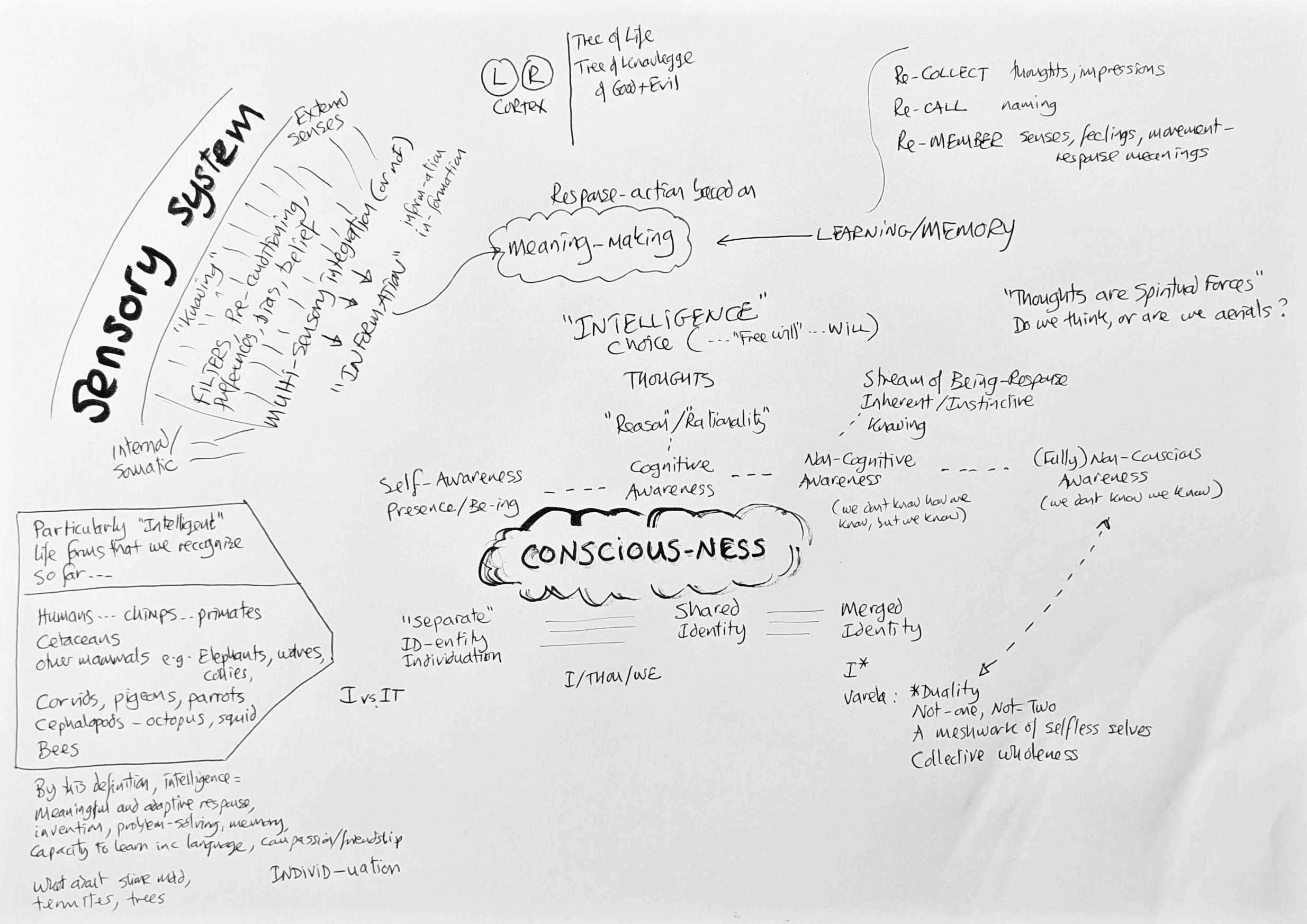
Click here to display full-size image (326kB)
References & Notes